
JUKI Mounter as the Core Hub: How to Build a Fully Synchronized SMT Production Line (Track, SMEMA, SECS/GEM, Line Balancing Guide)
In the era of Intelligent Manufacturing 2.0, SMT production lines have evolved from “single-equipment performance competition” to “system collaboration-driven efficiency”. JUKI mounter compatibility with peripheral equipment directly determines the overall capacity and yield of the production line. This article focuses on JUKI SMT line collaboration and SMT production line optimization, explaining how to take JUKI pick and place machine integration as the core to build a highly efficient and synchronized SMT production system.
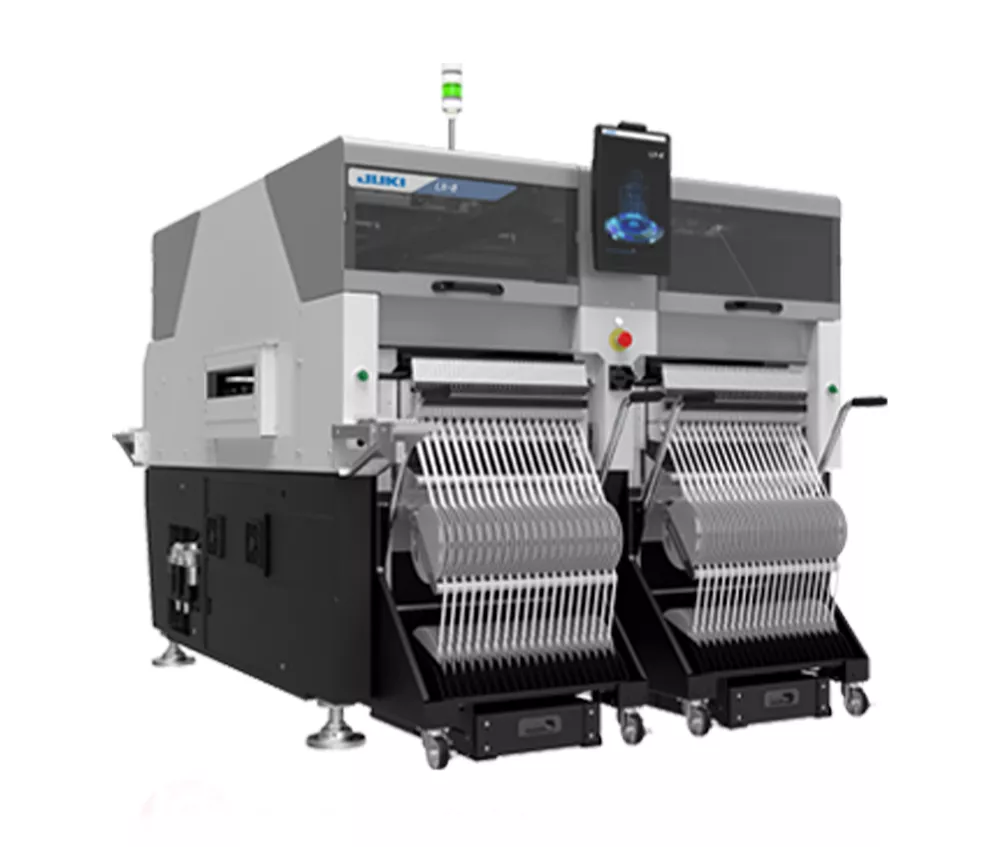
I. Core Logic of SMT Collaborative Production: From Single-Point Efficiency to System Optimization
Many electronic manufacturers once faced the dilemma of “high theoretical capacity but low actual output” — investing in high-performance JUKI mounters but ignoring JUKI pick and place machine integration with old printers or non-standard loaders. This leads to the awkward situation where “mounters wait for materials while printers fall behind”.
A real case illustrates this: A consumer electronics factory equipped with JUKI RS-1 mounters has a theoretical capacity of 36,000 points per hour. However, due to poor track connection in SMT with the front-end DEK printer, the average PCB transfer delay reaches 2 seconds per time, resulting in a 10% daily capacity loss. This proves that JUKI RS-1 real capacity depends not only on the machine itself but also on the overall collaboration effect.
SMT production is an interlocking chain of “material flow + information flow”. The placement rhythm and data interaction of JUKI mounters must be synchronized with upstream and downstream equipment to form a coordinated “production community”.
II. Hardware Foundation for JUKI Mounter Compatibility: Track and SMEMA Interface
Hardware compatibility is the first threshold for JUKI SMT line collaboration, focusing on two core points: track connection in SMT and SMEMA interface signal interaction.
1. Track Connection: Ensure Smooth PCB Handover
JUKI mounters adopt the international universal SMEMA standard, with a default track height of 940mm ± 5mm. When matching with different brands of equipment, two key parameters need to be focused on:
-
Track width adjustment range: It is recommended to cover all PCB sizes in production (especially flexible boards and special-shaped boards) to avoid jamming or missing boards.
-
Transfer speed synchronization: When collaborating with HELLER reflow ovens, the output speed of the mounter track should be consistent with the oven inlet speed, usually set to 1.2-1.5m/min to prevent PCB accumulation or collision.
Practically, installing infrared sensors at track joints can monitor PCB transfer status in real-time and trigger alarms for deviations, reducing production risks.
2. SMEMA Interface: Reliable Signal Transmission
The SMEMA interface is the key to realizing signal interaction between SMT equipment. JUKI mounters’ I/O interfaces support stable connection with mainstream brand equipment. For example:
-
When matching with GKG printers, the “print completion signal → mounter standby release” linkage can be set to achieve “immediate printing and placement”.
-
When the mounter has material jamming, it sends a “pause signal” to the upstream loader in time to avoid PCB accumulation.
For old equipment that does not support SMEMA, configuring a signal conversion module in advance can effectively solve compatibility issues.
III. Data Link for JUKI Integration: SECS/GEM and OPC UA Communication
If hardware matching is “physical coordination”, then SECS/GEM communication SMT and OPC UA protocol integration are “neural transmission”, which is crucial for realizing intelligent production.
JUKI mounters have built-in multiple industrial communication protocols, which can realize two core values through seamless docking with MES systems:
-
Real-time data sharing: The mounter can receive the solder paste printing parameters (printing pressure, scraper speed) transmitted by the printer in real-time, and automatically adjust the placement force. For fine-pitch BGA components, when the printing pressure is 0.2MPa, the nozzle pressure can be synchronized to 0.08MPa to avoid pad damage.
-
Full-process traceability: It is recommended to unify the data coding format during the planning phase. For example, the PCB unique identification code (SN code) can adopt a 16-character format to ensure smooth connection of traceability from printing to soldering.
IV. Key to SMT Line Optimization: Production Rhythm Balancing
SMT line balancing is the ultimate goal of collaborative production, ensuring that there are no bottlenecks or idleness in each link. The placement cycle of JUKI mounters needs to be accurately matched with the front and rear processes, which can be achieved through “time calculation + equipment configuration”.
1. Single Process Time Matching
Taking JUKI NX-1 as an example, its placement cycle is 0.08 seconds per point. For a 1000-point PCB, the single-board placement time is about 80 seconds. At this time:
-
The front-end printer should control the single-board printing time within 60-70 seconds.
-
The rear-end reflow oven should choose a model with a length of more than 3.2 meters to ensure soldering is completed within 80 seconds.
2. Cellular Layout Optimization
For multi-variety and small-batch production, forming independent production units with “JUKI mounter + dedicated loader/unloader + AOI testing equipment” can reduce equipment switching time. Reserving 1-2 PCB buffer positions between units can ensure production continuity when equipment is temporarily shut down.
V. JUKI Mounter and Peripheral Equipment Collaboration Focus Table
|
Collaboration Link
|
Key Collaboration Points
|
Attention Items
|
|---|---|---|
|
Printer → JUKI Mounter
|
SMEMA ready/complete signal, printing parameter transmission
|
Track speed synchronization, PCB center reference alignment
|
|
JUKI Mounter → Reflow Oven
|
Track speed matching, PCB output signal
|
Avoid PCB accumulation at the oven inlet
|
|
JUKI Mounter → MES System
|
SECS/GEM protocol docking, data real-time upload
|
Unified SN code format and data transmission frequency
|
VI. Frequently Asked Questions (FAQ) About JUKI Mounter Integration
Q1: How does JUKI RS-1 integrate with DEK or GKG printers?
First, confirm that both devices support the SMEMA interface; if the printer is an old model, configure a signal conversion module. Then adjust the track height to 940mm ± 5mm, synchronize the track speed to 1.2-1.5m/min, and set the “print completion → mounter startup” linkage signal to ensure seamless connection.
Q2: How to solve SMEMA signal mismatch between old equipment and JUKI mounters?
Two solutions are available: 1) Install a professional SMEMA signal converter to convert the old equipment’s signal format to be compatible with JUKI; 2) For equipment with extremely old models, replace the signal control board with a new one that supports SMEMA standards, which is more cost-effective in the long run.
Q3: What is the ideal PCB transfer speed for JUKI + HELLER combination?
It needs to be determined according to the PCB size and process requirements. Generally, for PCBs with a size of 100mm-300mm, the transfer speed is set to 1.2-1.5m/min, which can balance production efficiency and transfer stability. For larger PCBs (over 300mm), it is recommended to reduce the speed to 0.8-1.0m/min to avoid warping.
Q4: How to balance cycle time between printer, mounter and reflow oven?
First, calculate the standard cycle time of each process: take the JUKI mounter’s single-board placement time as the benchmark. Then adjust the printer’s scraper speed and stencil separation speed to shorten the printing time by 10%-15% compared with the placement time. Finally, select the reflow oven model according to the total time, and ensure the oven’s throughput time matches the placement rhythm.
Get Professional JUKI Mounter Integration Support
Whether you need to evaluate the compatibility of JUKI mounters with existing printers, AOI, loaders/unloaders and reflow ovens, or want to optimize the production rhythm of the SMT line to improve capacity, we provide free one-on-one SMT line matching consultation. Our team of SMT engineers with 10+ years of experience will tailor the most suitable integration solution for you. Contact us now to start your efficient production journey.
