



The Mass Flow Controller (MFC) is an important equipment component in the vacuum Chemical Vapor Deposition (CVD) process. Products with a flow range of 20 – 3000 sccm can meet various gas flow control requirements. The relevant introduction is as follows:

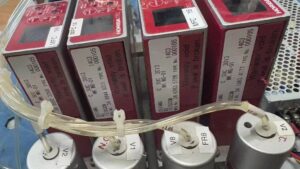
HORIBA D519MG Pressure Insensitive Mass Flow Module
Working Principle: It is based on heat conduction or differential pressure measurement technology. The thermal MFC combines a heating element with a temperature sensor. When gas flows through, it takes away heat, creating a temperature difference between the upstream and downstream. This temperature difference is proportional to the mass flow rate. The controller adjusts the heating power to maintain a constant temperature difference, thus achieving closed – loop control of the flow rate. The differential pressure type MFC uses a laminar flow element to convert the gas into regular laminar flow. It calculates the volume flow rate by measuring the pressure difference before and after the throttling device, and then converts it into the mass flow rate by combining the data from the temperature and pressure sensors.
Features and Advantages: Taking HORIBA’s related products as an example, they are characterized by precision and stability, and are suitable for the high – demand semiconductor and optoelectronic manufacturing environments. They are equipped with IGS to G1/8 internal thread connectors, which are easy to install. An OMRON external display meter can also be optionally configured, providing intuitive operation and clear data reading.
Application Fields: It is mainly used in the vacuum CVD process in semiconductor manufacturing. It is necessary to accurately transport inert,

HORIBA D519MG Pressure Insensitive Mass Flow Module
corrosive, and reactive gases to the process chamber to ensure precise control of the gas flow rate, which is crucial for improving the quality of semiconductor products and production efficiency.


