
FUJI NXT Pick-and-Place Machine: The “Flexibility King” of SMT Modular Production, Full-Scenario Adaptation from R&D to Mass Production
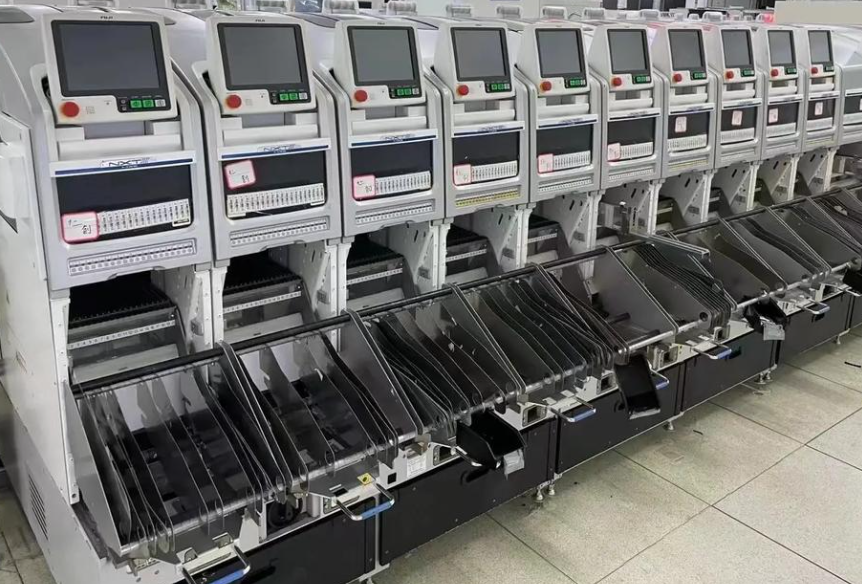
In the era of electronic manufacturing transforming towards “high-mix, high-precision, and fast-response,” the “flexibility” and “stability” of pick-and-place machines have gradually become the core of production line competitiveness. The FUJI NXT series pick-and-place machines, centered on modular design, cover a full range from entry-level to high-end precision models. They can not only meet the small-batch testing needs of small R&D laboratories but also support the 24/7 automated mass production of large contract manufacturers, becoming a benchmark product for “full-scenario adaptation” in the SMT industry.
I. Core Competitiveness: Modular Design, Redefining SMT Production Flexibility
The soul of the FUJI NXT series lies in “modularity” — it is not a single device but a “configurable platform” composed of independent modules such as mounting heads, feeders, vision systems, and conveyors. This design fundamentally solves the pain points of traditional pick-and-place machines, such as “bearing full energy consumption alone and halting the entire machine if one part fails,” bringing three core advantages:
I. Core Competitiveness: Modular Design, Redefining SMT Production Flexibility
No need for full machine replacement — simply add/reduce mounting head modules or feeder modules to quickly adjust production line capacity. For example, the M3 III (single module) and M6 III (dual module) models of the NXT III series: the former supports up to 20 component types (based on 8mm tape), while the latter can be expanded to 45 types. The PCB size adaptation range covers from 510×460mm (M3 III) to 510×610mm (M6 III), compatible with both large industrial control boards for automotive electronics and small PCB boards for consumer electronics.
2. Rapid Maintenance: Failures Don’t “Disrupt the Entire System”
3. Precise Control: Independent Module Calibration for Stable Accuracy
II. Analysis of Mainstream Models: From R&D to Mass Production, There’s Always a Fit for Your Scenario
1. Entry-Level: NXT-MEGA 3 — The “Cost-Effective Choice” for Small-Scale R&D/Testing
- Core Positioning: Small-batch production/sample testing for laboratories and startup electronics factories
- Key Advantages: Intuitive icon-based operation interface (replacing text commands) for quick onboarding of new operators; moderate price without large-scale capital investment; supports standard components from 0402 to 5050, meeting the mounting needs of initial R&D
- Typical Scenarios: Sample prototyping for consumer electronics startups, SMT teaching in university laboratories, small-batch customized PCB production (e.g., industrial sensors)
2. Mid-Range: NXT III (M3 III/M6 III) — The “Efficiency Workhorse” for Medium-Scale Production Lines
- Core Upgrades: Compared to the previous generation, the NXT III features faster XY robots. Equipped with the newly developed “flying vision camera” (identifies components while moving, no wasted time), the H24G high-speed mounting head reaches 37,500 CPH (components per hour) in “production priority mode” — 44% faster than the NXT II
- Adaptable Scenarios: Medium-scale factories with daily output of tens of thousands to hundreds of thousands of PCBs, such as automotive electronics in-vehicle infotainment boards (high-mix, small-to-medium batch) and smart home PCB assembly (frequent line changes)
- Detail Highlights: Dual-conveyor design enables “0-second PCB loading” (continuous operation), with a single-conveyor loading time of only 2.5-3.4 seconds. No long downtime is required for line changes; supports full-spec tapes from 8mm to 72mm, with expandable capacity up to 200+ feeder slots, allowing complex products to be fully mounted in one pass
3. High-End Precision: NXT-H — The “Precision Leader” for Cleanrooms/Semiconductor Packaging
- Special Capabilities: Designed specifically for “high-cleanliness + high-precision” scenarios, supporting Class 1000 cleanrooms (upgradeable to higher cleanliness levels with HEPA filters). It can directly pick components from wafers while being compatible with tray and tape feeding
- Precision Parameters: Adopts linear motor drive + ultra-high-resolution cameras for finer mounting pressure control, capable of handling fragile semiconductor components. The mounting accuracy is stably maintained at ±0.025mm, suitable for 01005″ micro-components and fine-pitch devices such as BGA/QFP
- Typical Users: Semiconductor packaging factories, medical device manufacturers (e.g., precision PCBs for ECG monitors), and high-end sensor production (e.g., automotive millimeter-wave radar)
4. Smart Factory-Level: NXT-R — The “Automation Hub” for Large-Scale Mass Production
- Core Breakthrough: Equipped with the “Automatic Feeder Exchange System” (Smart Loader). Operators only need to place tape cassettes at the buffer station, and the system automatically replaces feeders according to the production plan — even refilling materials during production, completely reducing manual intervention
- Intelligent Linkage: Can connect with FUJI’s Nexim integrated production system to achieve full-link data intercommunication of “production planning – material flow – equipment status,” supporting 24/7 unmanned production in “dark factories”; module layout can be customized on demand, and a single production line can be configured with multiple NXT-R modules to meet the demand for millions of annual output
- Adaptable Scenarios: Large EMS contract manufacturers (e.g., production lines for mobile phone brands), large-scale mass production of consumer electronics (e.g., tablet PC PCBs), and highly automated automotive electronics production lines
III. Practical Application Value: More Than “Mounting Components” — Reducing Costs and Increasing Efficiency
1. 20%-40% Capacity Increase: Balancing Speed and Precision
2. 30% Reduction in Maintenance Costs: Modularity + Compatibility with Previous Generations
3. Economical Energy Consumption: Balancing Efficiency and Low Carbon
IV. Selection Tips: How to Choose the “Most Suitable” NXT Model?
- Based on Production Scale: Choose NXT-MEGA 3 for small-batch R&D, NXT III for medium-scale production, and NXT-R for large-scale automation;
- Based on Component Types: Choose NXT III for standard components, NXT-H for micro/fragile components, and NXT-H for wafer picking;
- Based on Automation Needs: Choose the basic NXT III for factories with more manual intervention, and NXT-R (equipped with Smart Loader) for smart factory transformation;
- Based on Budget and Upgrade Plans: For limited budgets and existing NXT equipment, prioritize NXT III compatible with previous-generation modules to reduce initial investment.

Add comment